

NEWS & BLOGS

Why the World Is Running Out of Places to Dump Obsolete Refrigeration Equipment
Why the World Is Running Out of Places to Dump Obsolete Refrigeration Equipment
What the EU's new export ban means for open chiller buyers in Southeast Asia, the Middle East, and Latin America
For years, one quiet reality shaped the global refrigeration equipment trade: when developed markets tightened refrigerant rules, older high-GWP equipment often didn't disappear — it got exported to markets with fewer restrictions. As of 2025, that path is closing.
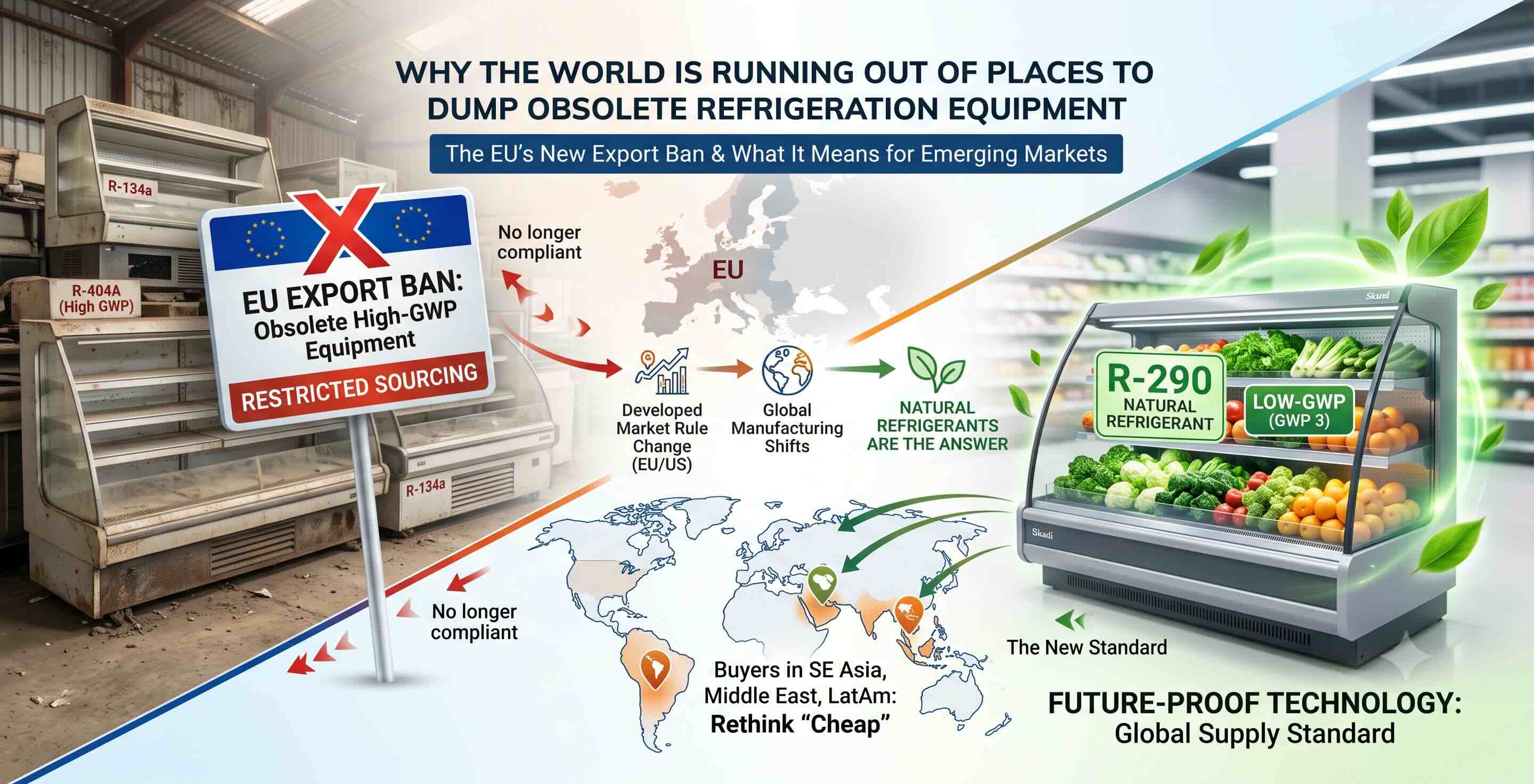
The EU's revised F-gas regulation now includes an export ban on refrigeration and AC systems using refrigerants with a Global Warming Potential (GWP) of 1,000 or higher — specifically for systems that can't legally be sold inside the EU. The European Commission has been explicit about why: to stop obsolete, non-compliant equipment from being routed into developing markets instead of being phased out entirely.
If you're sourcing open chillers, display cases, or other commercial refrigeration equipment for Southeast Asia, the Middle East, or Latin America, this changes the calculus on what "cheap" actually means.
What's Actually Changing
In the United States, under the AIM Act, new commercial refrigeration systems installed from January 1, 2026 are barred from using high-GWP refrigerants like R-404A (GWP 3,920) or R-134a (GWP 1,430). Self-contained display cases have been capped at a GWP of 150 since 2025, with the limit extending to all retail refrigeration systems at GWP 300 by 2027.
In the EU, the 2024 F-gas regulation goes further than a domestic phase-down — the new export ban means manufacturers can no longer legally move non-compliant, high-GWP equipment out of the EU to markets that haven't yet caught up on regulation. The stated intent is direct: prevent equipment dumping into developing markets.
The common answer across both frameworks is the same: natural refrigerants. R-290 (propane) has a GWP of just 3 — roughly 1,300 times lower than R-404A — and is already the standard compliance path for self-contained and open chiller-style display equipment.
Why This Matters Even If You're Not Buying From the EU or US
Here's the part worth sitting with: this isn't only a US/EU compliance story. It's a signal about where global equipment supply is heading.
As two of the largest refrigeration markets close the door on high-GWP equipment — both domestically and, in the EU's case, for export — the manufacturing base globally shifts toward low-GWP designs as the default, not the premium option. Buyers in emerging markets who keep sourcing older refrigerant technology aren't just taking on an environmental question; they're increasingly buying equipment that's becoming harder to source parts and service for, as manufacturers standardize around R-290 and other natural refrigerants.
There's also a reputational angle worth considering. As international buyers, retailers, and certification bodies pay closer attention to refrigerant compliance, importing equipment that would no longer be legal to sell in the EU or US isn't a great long-term look for a growing retail or foodservice brand.
What This Means for Your Next Open Chiller Order
A few practical questions worth asking before your next purchase order:
- What refrigerant does the unit actually use, and what's its GWP? Don't assume — ask for the spec sheet.
- Is this the same spec being sold into the EU or US, or a different (older) build for other export markets? If a supplier maintains two different refrigerant standards for different regions, ask why.
- Does your local market have refrigerant regulation on the horizon? Several markets in the Middle East and Latin America are moving toward alignment with international GWP standards — sourcing R-290 equipment now avoids a retrofit or replacement cycle later.
Where Skadi Fits
Skadi's Open Chiller line is built around R-290 as the standard refrigerant, not an upsell option. Every unit ships with clear refrigerant specification and GWP documentation, so you're not left guessing whether what you're buying today will still be compliant — or sourceable — in three years.
We'd rather you ask these questions of any supplier, including us, before you commit to an order. The equipment that looks cheapest on a quote sheet isn't cheap if it's obsolete before it arrives.
FAQ
Is R-290 safe to use in commercial display equipment?
Yes — R-290 is widely used in self-contained and open chiller display cases globally. It's mildly flammable, which is why charge limits and system design (not just refrigerant choice) matter; reputable manufacturers design systems within approved charge limits for safe commercial use.
Does my country require R-290 or low-GWP refrigerants yet?
It depends on your market — not all Southeast Asian, Middle Eastern, or Latin American markets have adopted GWP limits yet. This isn't claiming they do. The point is that global supply is shifting toward low-GWP as the default regardless, which affects availability and long-term serviceability even where it isn't yet legally required.
What's the practical difference for my business if I buy an older refrigerant unit today?
Likely nothing immediately. The risk is medium-term: harder sourcing of compatible parts and service as manufacturers standardize on newer refrigerants, and potential resale or compliance friction if your market adopts stricter rules later.
Want to check whether your current open chiller spec is future-proof?
Contact our team for a refrigerant compliance review.